


PECB ISO-9001-Lead-Auditor Exam Syllabus Topics:
| Topic | Details |
|---|---|
| Topic 1 |
|
| Topic 2 |
|
| Topic 3 |
|
| Topic 4 |
|
Reference: https://pecb.com/en/education-and-certification-for-individuals/iso-9001/iso-9001-lead-auditor
PECB QMS ISO 9001:2015 Lead Auditor Sample Questions:
Question #1
An internal auditor of a manufacturer of polystyrene packaging products for the electronics industry raised a nonconformity against section 10.3 of ISO 9001 in Report IA202. The nonconformity (NC 3) stated:
" The reject rate of ' finished ' product of 9.7% needs improvement as it doesn ' t meet the stated objective of top management of 5%. " Just before the Closing meeting of a third-party audit, the audit team leader is invited to a meeting with the Quality Manager. He tells the audit team leader that a member of the audit team was seen taking photographs of the factory on his phone during the day and wants him suspended from the Closing meeting with any nonconformities raised by him rescinded. The issue of photographs was not discussed during the opening meeting.
Select the three options for how the audit team leader might deal with this situation.
A. Delay the Closing meeting until the audit team leader has consulted his audit programme manager at Head Office
B. Insist that the nonconformities must stand since they have been agreed by the team from other evidence gathered
C. State that the auditor will take no further part in the audit and all his photographs will be deleted
D. Advise the Quality Manager that he, as audit team leader, needs to speak to the auditor about the situation and he will report back to the Quality Manager once this is done
E. Apologise for the situation and ensure the Quality Manager that all photographs will be deleted during the Closing meeting
F. Advise the Quality Manager that the auditor will be reported to Head Office
Question #2
(Which of the following two options could be considered the most likely potential threats to impartiality in an audit context?)
A. Competence
B. Lack of Experience
C. Expert knowledge of the process
D. Your spouse is working in the organisation being audited
E. Consulting
F. Self-interest
Question #3
An audit team of three people is conducting a Stage 2 audit to ISO 9001 of an engineering organisation that manufactures sacrificial anodes for the oll and gas industry in marine environments. These are aluminium products designed to prevent corrosion of submerged steel structures. You, as one of the auditors, find that the organisation has shipped anodes for Project DK in the Gulf of Mexico before the galvanic efficiency test results for the anodes have been fully analysed and reported as required by the customer. The Quality Manager explains that the Managing Director authorised release of the anodes to avoid late delivery as penalties would be imposed. The customer was not informed since the tests very rarely fall below the required efficiency. You raise a nonconformity against clause 8.6 of ISO 9001.
Which of the following options for the best description of the nonconformity?
A. Products for Project DK have been released before product approval through the quality control process.
B. A retrospective concession was not sought from the customer once the test results had been approved by the Quality Manager.
C. The untested product was not recalled until the galvanic efficiency of the anodes was verified.
D. Release of the product without acceptable test results has been accepted by the customer for Project DK.
Question #4
You are carrying out an audit at a single-site organisation seeking certification to ISO 9001 for the first time.
The organization manufactures cosmetics for major retailers.
You are interviewing the Manufacturing Manager (MM).
You: " I would like to begin by looking at the cleaning controls. "
MM: " We record the cleaning of the equipment at the end of every batch. This document details the minimum cleaning frequency and the procedures to follow for all areas and each item of equipment. The person who carries out the cleaning puts their initial on the document and records the time and date alongside.
"
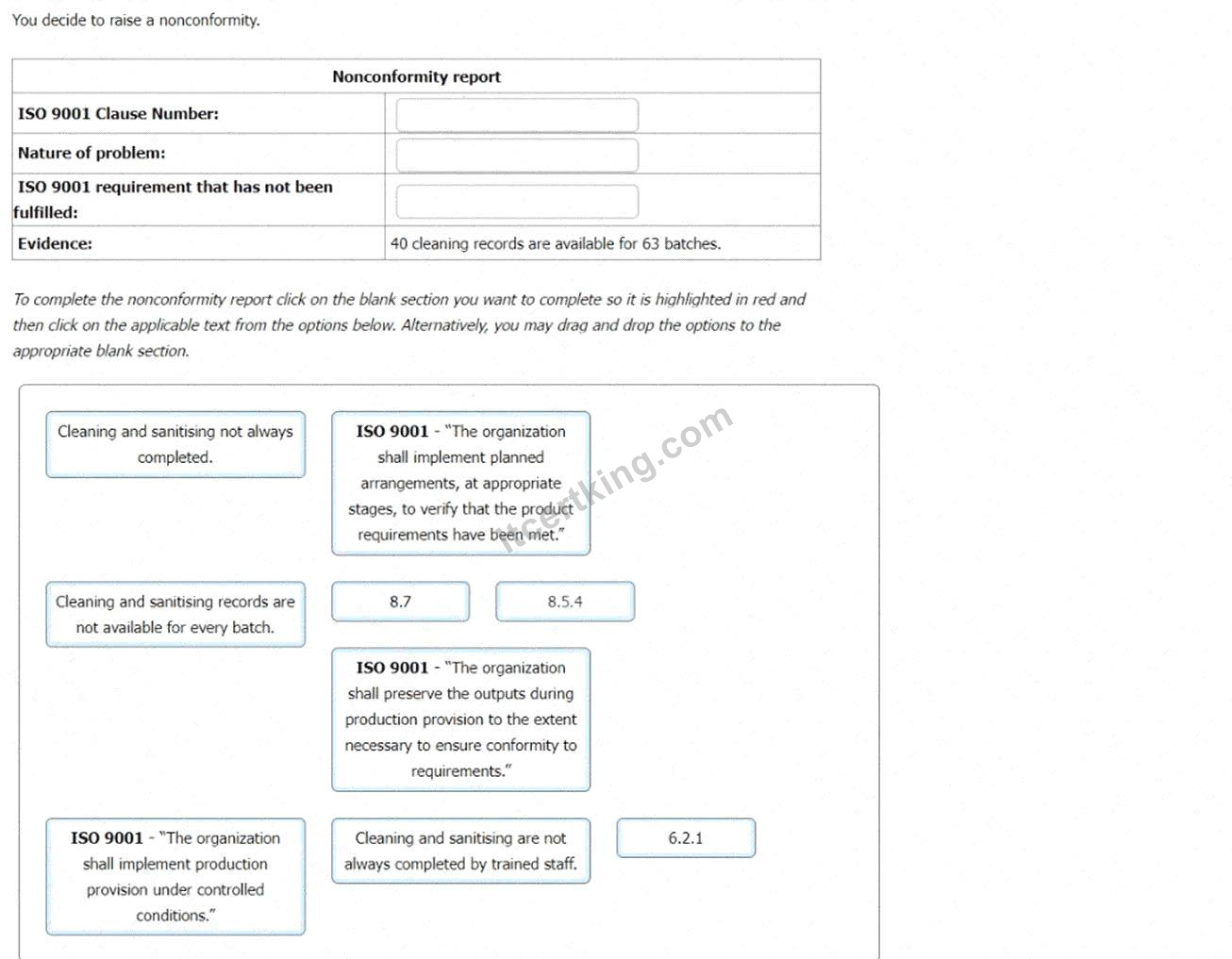
Narrative: You sample production records over 3-days and note down evidence of nonconformity as per the table below.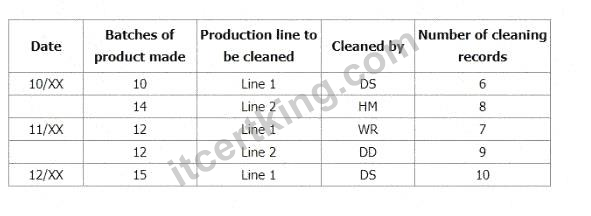
Question #5
You, as auditor, are in dialogue with the quality lead and managing director of a small business that supplies specialist laboratory equipment and furniture.
You: " I ' d like to look at how you manage change in the organisation. What changes have you made as a business, say, over the last 12 months? " Auditee: " We have made some strategic changes, the main one being that we no longer manufacture our own products in house. " You: " That sounds like quite a significant change. What has been the impact of that? " Auditee: " We now mainly sell other manufacturers ' products, under their brand names, and have outsourced manufacture of our own brand products to one of our suppliers. Unfortunately, we had to make six members of our staff redundant. This represents about 20% of our workforce, so this has been quite a challenging time. " You: " I ' m sure. What were the reasons for making the change? " Auditee: " Our manufacturing section was a small operation, and we struggled to cope with fluctuations in demand. During busy periods, we found it hard to meet lead times, and in quiet periods we had staff with little to do. This was having an impact on customer satisfaction and meant we had to charge premium prices that made our product uncompetitive. " You: " How did you go about the change? " The auditor asks to speak to the purchasing manager about the selection of the subcontractor to manufacture the company ' s own brand products.
You: " How did you choose a supplier to manufacture your products? "
Auditee: " We have had a long-term relationship with a supplier ABC Ltd - we gave them our design drawings, got them to complete a supplier questionnaire and run a couple of trial batches for us. We were happy with the result and we have used them ever since. " ISO 9001:2015, clause 8.4.1 outlines situations when controls need to be applied to externally provided processes, products and services. Which one of the following situations is applicable to this scenario?
A. Products and services are provided directly to the customer(s) by external providers on behalf of the organisation.
B. Products and services for which the customer(s) supplies materials
C. A process or part of a process is provided by an external provider as a result of a decision by the organisation.
D. Raw materials from external providers are intended for incorporation into the organisation ' s own products.
Solutions:
| Question #1 Correct Answer: A,B,D | Question #2 Correct Answer: D,F | Question #3 Correct Answer: A | Question #4 Correct Answer: Only visible for members | Question #5 Correct Answer: C |


 1606 Customer Reviews


 Quality and ValueITCertKing Practice Exams are written to the highest standards of technical accuracy, using only certified subject matter experts and published authors for development - no all study materials.
 Tested and ApprovedWe are committed to the process of vendor and third party approvals. We believe professionals and executives alike deserve the confidence of quality coverage these authorizations provide.
 Easy to PassIf you prepare for the exams using our ITCertKing testing engine, It is easy to succeed for all certifications in the first attempt. You don't have to deal with all dumps or any free torrent / rapidshare all stuff.
 Try Before BuyITCertKing offers free demo of each product. You can check out the interface, question quality and usability of our practice exams before you decide to buy.

