


Which Jobs Are Associated with Cisco 200-301 Exam?
Here are some of the most popular jobs that you can assume after attaining the new CCNA certification by acing the Cisco 200-301 test:
- Network Analyst.
- Systems Administrator;
- Network Administrator;
- Network Engineer;
According to Payscale.com, the average yearly salary that CCNA certification holders can get is $78,768.
Recommended Revision Book: Cisco 200-301 Official Cert Guide Library
How about studying with the official certification guide? It is written by IT professionals, verified by the industry experts, and designed with precision so all candidates preparing for the new CCNA test can never make a mistake with the official study guide. This is one of the best-selling books on the Cisco Press Store that covers everything you need to pass 200-301 exam. From giving an in-depth review of the test topics to help candidates with exam concept mastery, and preparing you for an amazing career in real life, there’s just so much you can achieve with the new CCNA official study guide. The author, Wendell Odom, tries to mix his expert mastery of fundamental networking concepts with emerging technologies to bring out the best in the candidates. This material will guide you through all the test objectives starting with networking fundamentals to IP services, automation, and programmability. If for some reason you can’t get this guide from the Cisco Press, you may want to check out the Amazon official page to grab your copy. It's available there at only $39.61.
Target Audience
According to Cisco, the new CCNA designation is well-suited to specific roles such as a network administrator and network support engineer. Some topics that are included in the certification exam would also suit CCNA technicians working alongside software developers in many organizations.
Cisco 200-301 Korean Exam Syllabus Topics:
| Section | Weight | Objectives |
|---|---|---|
| Network Access | 20% | - Configure the components of a wireless LAN access for client connectivity using GUI only such as WLAN creation, security settings, QoS profiles, and advanced WLAN settings - Describe physical infrastructure connections of WLAN components (AP, WLC, access/trunk ports, and LAG) - Configure and verify interswitch connectivity - Configure and verify Layer 2 discovery protocols (Cisco Discovery Protocol and LLDP) - Configure and verify VLANs (normal range) spanning multiple switches - Describe Cisco Wireless Architectures and AP modes - Describe the need for and basic operations of Rapid PVST+ Spanning Tree Protocol - Configure and verify (Layer 2/Layer 3) EtherChannel (LACP) - Describe AP and WLC management access connections (Telnet, SSH, HTTP, HTTPS, console, and TACACS+/RADIUS) |
| IP Connectivity | 25% | - Configure and verify single area OSPFv2 - Determine how a router makes a forwarding decision by default - Interpret the components of routing table - Describe the purpose of first hop redundancy protocol - Configure and verify IPv4 and IPv6 static routing |
| IP Services | 10% | - Configure and verify NTP operating in a client and server mode - Describe the use of syslog features including facilities and levels - Configure and verify inside source NAT using static and pools - Explain the forwarding per-hop behavior (PHB) for QoS such as classification, marking, queuing, congestion, policing, shaping - Explain the role of DHCP and DNS within the network - Configure and verify DHCP client and relay - Explain the function of SNMP in network operations - Describe the capabilities and function of TFTP/FTP in the network - Configure network devices for remote access using SSH |
| Security Fundamentals | 15% | - Define key security concepts (threats, vulnerabilities, exploits, and mitigation techniques) - Describe wireless security protocols (WPA, WPA2, and WPA3) - Differentiate authentication, authorization, and accounting concepts - Configure device access control using local passwords - Configure Layer 2 security features (DHCP snooping, dynamic ARP inspection, and port security) - Describe remote access and site-to-site VPNs - Describe security program elements (user awareness, training, and physical access control) - Describe security password policies elements, such as management, complexity, and password alternatives (multifactor authentication, certificates, and biometrics) - Configure and verify access control lists - Configure WLAN using WPA2 PSK using the GUI |
| Automation and Programmability | 10% | - Explain how automation impacts network management - Recognize the capabilities of configuration management mechanisms Puppet, Chef, and Ansible - Compare traditional networks with controller-based networking - Compare traditional campus device management with Cisco DNA Center enabled device management - Describe characteristics of REST-based APIs (CRUD, HTTP verbs, and data encoding) - Describe controller-based and software defined architectures (overlay, underlay, and fabric) - Interpret JSON encoded data |
| Network Fundamentals | 20% | - Configure and verify IPv6 addressing and prefix - Identify interface and cable issues (collisions, errors, mismatch) - Describe the need for private IPv4 addressing - Compare physical interface and cabling types - Describe switching concepts - Describe wireless principles - Compare TCP to UDP - Verify IP parameters for Client OS (Windows, Mac OS, Linux) - Explain the role and function of network components - Explain virtualization fundamentals (virtual machines) - Configure and verify IPv4 addressing and subnetting - Describe characteristics of network topology architectures - Compare IPv6 address types |
Cisco Certified Network Associate Exam (200-301 Korean Version) Sample Questions:
Question #1
데이터 플레인 내에서 발생하는 두 가지 네트워크 작업은 무엇입니까? (2개를 선택하세요.)
A. 대상 MAC 주소를 MAC 주소 테이블과 일치시킵니다.
B. 들어오는 ICMP 에코 요청에 응답합니다.
C. 라우팅 프로토콜을 실행합니다.
D. 수신 NETCONF RPC에서 구성을 변경합니다.
E. 802.1Q 트렁킹 헤더를 추가하거나 제거합니다.
Question #2
한 엔지니어가 NAT를 구성하여 소스 서브넷인 10.10.0.0/24를 세 가지 주소 중 하나로 변환하고 있습니다.
192.168.30.1, 192.168.3.2, 192.168.3.3 중 어떤 구성을 사용해야 합니까?

A. 옵션 A
B. 옵션 D
C. 옵션 C
D. 옵션 B
Question #3
첨부된 그림을 참조하십시오. 10.220.100.96/27 경로가 매우 불안정합니다. 동일한 경로에 대해 라우터 A, B, C, D로 연결되는 백업 경로가 각각 다른 방식으로 설정되어 있습니다. 라우터 Y의 라우팅 프로토콜 기본 설정은 변경되지 않았습니다. 10.220.100.96/27에 대한 현재 경로를 사용할 수 없게 되면, 라우터 Y는 어떤 라우터를 사용하여 10.220.100.96/27로 트래픽을 라우팅할까요?
A. 라우터 A
B. 라우터 B
C. 라우터 D
D. 라우터 C
Question #4
DHCP 또는 DNS와 같은 분산 서비스의 애니캐스트 주소에 적합한 IPv6 주소 범위는 무엇입니까?
A. FE80::1/10
B. 2001:db8:0234:ca3e::1/128
C. 2002:db84:3f37:ca98:be05:8/64
D. FF00:1/12
Question #5
전시물을 참조하십시오.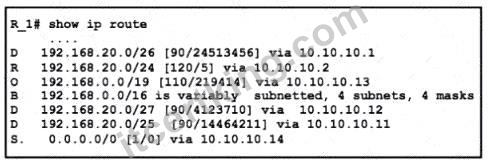
패킷이 192.168.10.1에서 192.168.20.75의 목적지 IP 주소로 이동하고 있습니다. 라우터는 이 패킷에 대해 어떤 다음 홉을 선택할까요?
A. 10.10.10.12
B. 10.10.10.11
C. 10.10.10.14
D. 10.10.10.1
Solutions:
| Question #1 Correct Answer: A,E | Question #2 Correct Answer: C | Question #3 Correct Answer: A | Question #4 Correct Answer: B | Question #5 Correct Answer: B |


 0 Customer Reviews
 Quality and ValueITCertKing Practice Exams are written to the highest standards of technical accuracy, using only certified subject matter experts and published authors for development - no all study materials.
 Tested and ApprovedWe are committed to the process of vendor and third party approvals. We believe professionals and executives alike deserve the confidence of quality coverage these authorizations provide.
 Easy to PassIf you prepare for the exams using our ITCertKing testing engine, It is easy to succeed for all certifications in the first attempt. You don't have to deal with all dumps or any free torrent / rapidshare all stuff.
 Try Before BuyITCertKing offers free demo of each product. You can check out the interface, question quality and usability of our practice exams before you decide to buy.

